
A Beginner's Guide to Bitcoin: What It Is, How It Works, and Why It's Here to Stay
This beginner's guide to Bitcoin is for anyone who’s thought, “I really should figure out what this Bitcoin thing is all about.” You’re not late — and you don’t need to be a tech expert to understand the basics.
Free Crypto Courses
Build a foundation before you invest. Learn how Bitcoin, blockchains, and wallets work in plain English.
Get three free beginner-friendly courses plus an advanced security toolkit when you’re ready to go deeper.
If you’ve ever thought, “I really should figure out what this Bitcoin thing is all about,” you’re not alone. Every day, thousands of people start asking the same question — especially as they hear about governments, major investment firms, and even pension funds getting involved.
The good news? It’s not too late to learn, and it’s certainly not too late to benefit. This article will explain Bitcoin in simple terms, show you how it’s performed over time, and give you a peek at what experts think it could do in the future. No jargon, no hype — just the basics to help you understand what all the fuss is about.
So, What Exactly Is Bitcoin?
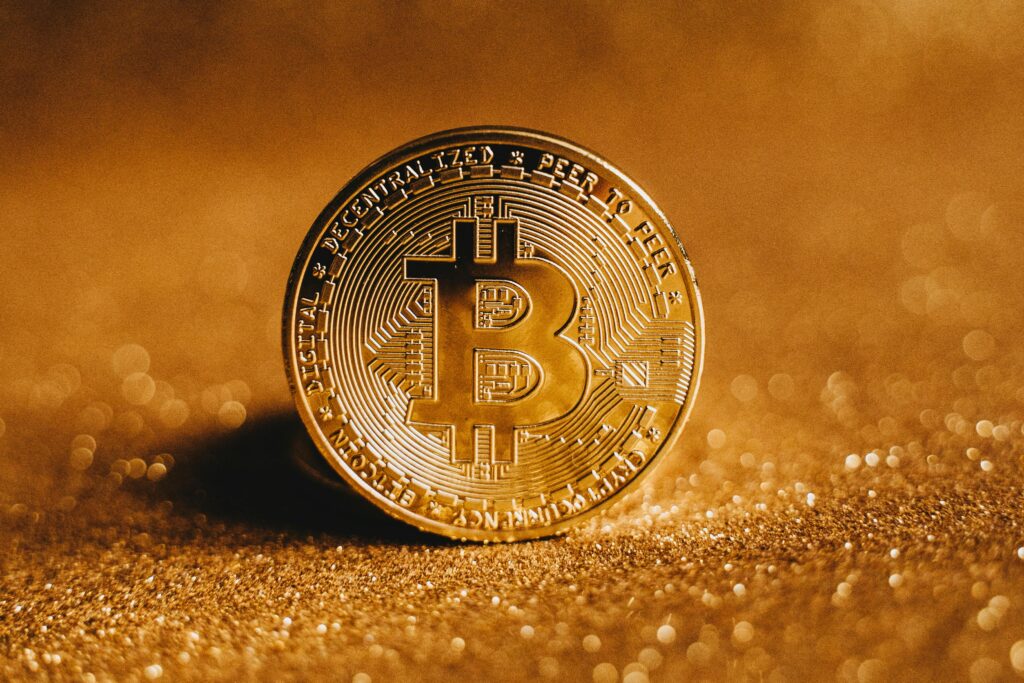
Bitcoin (BTC) is a form of digital money. It isn’t printed like notes or coins — it exists entirely on computers. But unlike regular money, it’s not controlled by any government or bank. Instead, it runs on something called the blockchain, a kind of digital ledger that records every transaction across a global network of computers.
Think of it like a public spreadsheet that anyone can see, but no one can secretly change. Every Bitcoin transaction is added to this ledger, and once it’s in, it can’t be edited or deleted.
Bitcoin was created in 2009 by an anonymous person (or group) using the name Satoshi Nakamoto. The idea was simple but revolutionary: create a form of money that doesn’t rely on banks or governments, is limited in supply, and can be sent anywhere in the world in minutes.
The Supply Cap: Why Only 21 Million Matters
One of the most important things to understand about Bitcoin is that it’s limited. There will only ever be 21 million Bitcoin. That’s it. Ever.
Why does that matter? Because scarcity creates value. Imagine if only 21 million houses existed in the world — prices would skyrocket. Bitcoin works in a similar way. Unlike traditional currencies, where governments can print more money whenever they like, Bitcoin’s supply is locked.
In contrast, fiat currencies (like the U.S. dollar) can be increased at will. In recent years, a huge amount of new money has been created, which is one reason people worry about inflation and are looking for alternatives like Bitcoin.

Past Performance: What If You Had Bought Earlier?
Bitcoin has been the best-performing asset of the past decade — by far.
While the S&P 500 (which includes companies like Apple, Google, and Amazon) returned around 160% over the past 10 years, Bitcoin returned more than 10,000% over the same period.
To put that into perspective:
- If you invested $1,000 in Bitcoin in 2015: It would be worth roughly $350,000 today (2025).
- If you invested $1,000 in Bitcoin in 2020: You’d have around $7,500–$10,000 today depending on when you bought.
Of course, past performance is not a guarantee of future results. Bitcoin has had its ups and downs — and some very steep drops. But overall, the long-term trend has been strong, and more people are now seeing it as a long-term store of value — like digital gold.
Free Crypto Starter Pack
Get a simple bundle to help you approach Bitcoin and crypto calmly and safely.
- 5 core crypto guides in plain English
- Access to investment calculators to test scenarios
- Free beginner-friendly courses and micro lessons
No spam. Just independent crypto education you can actually understand.
Institutional and Government Adoption in 2025
Until a few years ago, Bitcoin was seen as a fringe investment. Not anymore. In 2024 and 2025, we’ve seen huge players enter the space:
- BlackRock, the world’s largest asset manager, now offers a spot Bitcoin ETF (exchange-traded fund), making it easier than ever for traditional investors to buy BTC.
- Fidelity, ARK Invest, and Vanguard are offering crypto investment options in certain portfolios and retirement accounts.
- Countries like El Salvador and the Central African Republic now hold Bitcoin as part of their national reserves.
- U.S. regulatory attitudes have improved, with clearer rules that give both investors and institutions more confidence to participate legally and safely.
All of this signals one thing: Bitcoin is becoming mainstream.

How Bitcoin Compares to Traditional Investments
The S&P 500 has long been a benchmark for investors, returning around 7–10% per year on average over the last 50 years (after inflation).
Bitcoin, on the other hand, has averaged a compound annual growth rate (CAGR) of over 100% since its creation. That pace is slowing as the market matures, but it still outpaces most traditional assets by a wide margin.
Let’s say you want to invest $1,000 in Bitcoin today. What could that look like in the future, based on different scenarios?
Bitcoin Price Projections: What Experts Think
Here’s what some leading voices in the crypto and investment world are projecting for Bitcoin’s future, based on models from organisations like ARK Invest, Fidelity, and MicroStrategy.
| Timeframe | Bear Case | Base Case | Bull Case |
|---|---|---|---|
| 5 Years | $100K | $250K | $500K |
| 10 Years | $150K | $600K | $1 million+ |
| 20 Years | $250K | $1.5 million | $5 million+ |
These numbers might seem extreme, but they’re based on the idea that Bitcoin will continue growing as more people, companies, and governments use it as a savings tool — much like gold or prime real estate.
The Bottom Line: It’s Not Too Late
If you’re just starting to learn about Bitcoin, that’s perfectly okay. You don’t have to be an expert, and you definitely don’t need to buy a whole Bitcoin — you can start with as little as a few dollars.
The most important thing is understanding why it’s valuable: it’s limited in supply, global, difficult to shut down, and increasingly seen as a long-term hedge against inflation and currency debasement.
If you want more step-by-step explainers, you can explore our dedicated Bitcoin Guides hub, browse other articles in the Media Hub, or visit the Crypto Education Hub from the home page.
As always, do your own research, never invest more than you can afford to lose, and consider speaking with a financial advisor. But know this: you’re not late — you’re still early compared with where Bitcoin could be heading over the next decade.
Mini-FAQ: Quick Bitcoin Questions
Do I need to buy a whole Bitcoin?
No. Bitcoin is divisible into tiny pieces called satoshis. You can buy $10, $50, or $100 worth — you don’t need to buy a full coin.
Is it too late to invest in Bitcoin?
No one can predict the future, but many institutions and countries are only just starting to adopt Bitcoin. It’s more mature than it was years ago, but global adoption is still early.
Is Bitcoin safe?
The Bitcoin network itself has proven extremely secure. The biggest risks usually come from how people store their coins (exchanges, poor passwords, scams). Learning about wallets and security is just as important as the investment itself.
Free Crypto Courses
Turn “I should really learn this” into calm, structured progress with crypto.
Work through three free courses at your own pace, plus an advanced security toolkit when you’re ready.