

What Crypto Can Be Used For (Real-World Examples)
If crypto feels like a confusing mix of price charts, hype, and jargon… you’re not alone. Underneath the noise, there’s a simple idea: blockchain is a new way to keep records, and crypto is the value layer that lets those records move and interact.
The easiest comparison is the early internet. At first it looked like “emails and weird websites.” Then it quietly became online banking, shopping, maps, messaging, and the backbone of modern life. Crypto and blockchain are similar: many of the useful applications are quiet, practical, and don’t look like “coins” at all.
This guide is designed to open your mind a bit — not with hype, but with clear examples of what crypto can do when it’s used as infrastructure. Some of these use cases are already here. Some are still early. But together, they explain why this technology keeps showing up in finance, tech, and even everyday business.
Table of Contents
The big idea: blockchain is a shared record (that nobody can quietly “edit”)
The simplest explanation of blockchain is this: it’s a shared notebook. New entries get added in order, everyone can verify what’s written, and once something is written down it’s extremely difficult to change without leaving fingerprints. The correct term here is distributed ledger (called a “distributed ledger”).
The reason that matters is that much of modern life is powered by records: bank balances, transaction histories, ownership, warranties, permissions, titles, tickets, and contracts. In traditional systems those records live inside company databases — which means the company decides what the record says, who can access it, and what happens if there’s a dispute.
Blockchain introduces another option: a record that can be shared across many computers, where rules for adding new entries are transparent. That doesn’t magically make it perfect, but it does change the power balance. If the record is shared and verifiable, it’s harder for one party to quietly rewrite history. That’s why blockchain shows up in finance, supply chains, identity, and even digital media. (If you want to understand the mechanics, our Blockchain Guides hub breaks it down step-by-step — to learn more, click here.)
Now, let’s translate that into real-life use cases. The goal isn’t to convince you that crypto is “the future of everything.” It’s to give you enough clarity that you can spot what’s genuinely useful, what’s experimental, and what’s pure marketing.
1) Payments (everyday transfers)
In plain English: crypto can be used to send value directly from one person to another — like a bank transfer, but without needing a bank to approve it. The correct term is peer-to-peer payments (called “P2P payments”). This is one of the oldest and simplest uses of crypto, and it still matters because it proves the core concept: value can move across the internet the way information does.
That doesn’t automatically make it better than your bank for everyday life. Banks can reverse mistakes. They can freeze fraud. They provide consumer protections. But crypto has a different advantage: it’s always-on, global, and permissionless. If the network is running, you can send. If you’re sending across borders, that “always-on global rail” can be useful — especially when traditional systems are slow, expensive, or restrictive.
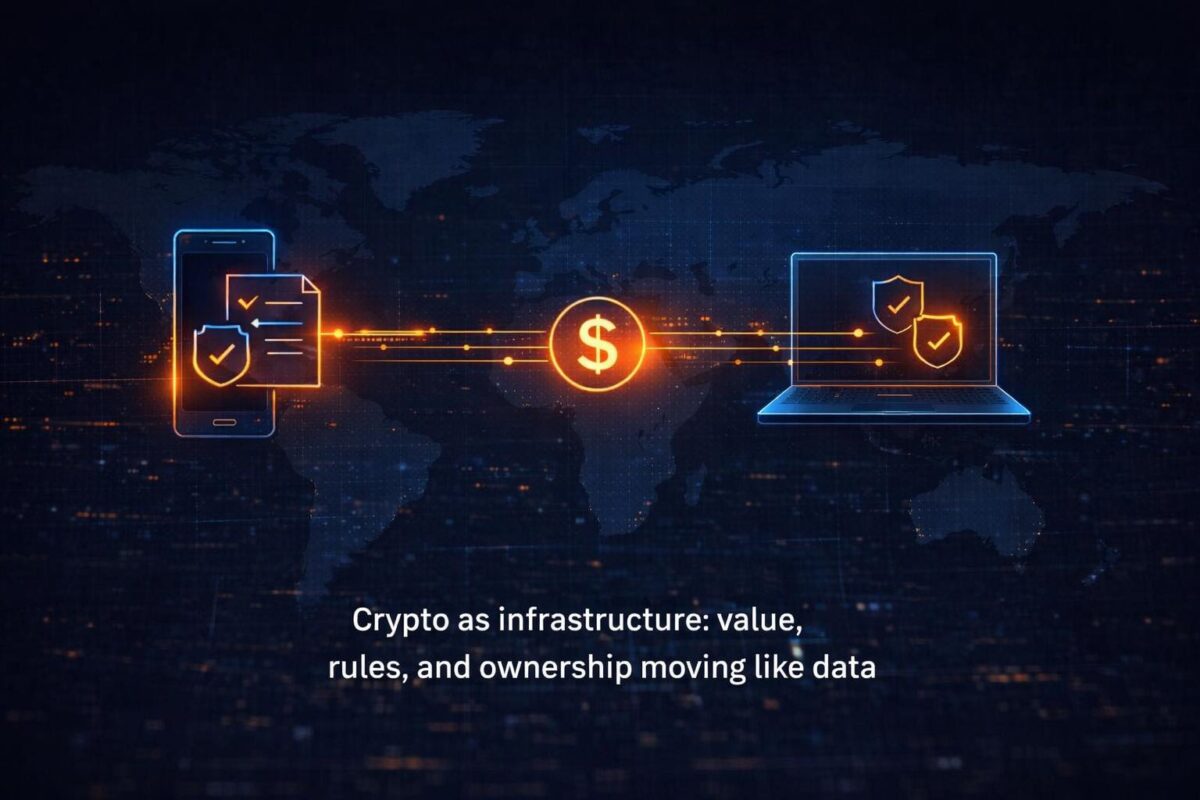
Here’s the mind-opening bit: crypto isn’t just “digital money.” It’s digital transfer with built-in settlement. When you use a card, you get an authorisation first, then settlement later. With crypto, settlement is part of the transaction. That’s why people say it’s “money that moves like email.”
And yes — scammers exist. Always verify the full address, not just the first and last few characters. The safest habit is treating every send like a flight checklist: slow, deliberate, and verified. That one behaviour prevents most “I sent it to the wrong place” stories.
2) Remittances (sending money overseas)
Remittances are money sent home to family overseas (called “remittances”). It’s one of the biggest financial flows on earth — and it’s often punishingly expensive. Fees stack up. Exchange rates get clipped. Transfers take time. And the person receiving the money may have limited banking access, which adds friction at the worst possible moment.
Crypto can reduce the “distance penalty.” Not always — it depends on the on/off ramps (how you get in and out), the network you use, and how the recipient wants to receive value. But when the pathway is smooth, it can be faster and cheaper than traditional rails, especially for smaller transfers where fees are disproportionate.
The mind-opening part here is bigger than remittances: crypto introduces an alternative settlement network that can operate alongside banking. You don’t have to abandon banks to appreciate what that means. Competition and alternatives matter, and in some countries, an alternative is the difference between “possible” and “impossible.”
3) Stablecoins (digital dollars)
Stablecoins are cryptocurrencies designed to stay near the value of a normal currency (often the US dollar). In plain English: they’re “digital dollars” you can send like crypto. The correct term is stablecoin (called a “stablecoin”). They’re not exciting in the way meme coins are exciting — but they’re useful in the way plumbing is useful: you only notice it when it’s missing.
Stablecoins solve a practical problem: volatility. If you want to move value quickly, pay someone, or send money overseas, the last thing you want is for the value to swing 10% while you’re mid-transaction. Stablecoins aim to keep value relatively stable, so the “crypto rail” becomes useful for everyday movement of money-like value.
This is also why stablecoins are often described as crypto’s bridge to everyday finance. They can make cross-border transfers smoother, enable businesses to settle invoices faster, and reduce reliance on slow banking rails — especially in places where accessing USD is difficult.
If you want a broader “foundation” explanation of what cryptocurrencies actually are and why so many types exist, to learn more, click here.
4) Saving & store of value (the “digital gold” idea)
Some people use Bitcoin as a long-term savings tool. In plain English: it’s an asset with a fixed supply, designed so nobody can print more whenever they want. The correct term is store of value (called a “store of value”). This use case is controversial, and that’s fine — but it’s important to understand why it exists.
In countries with unstable currencies, high inflation, or unreliable banks, the ability to hold an asset yourself — without needing permission — can be powerful. It’s not about getting rich quickly. It’s about having an option that doesn’t depend on a local institution behaving perfectly for decades.
In more stable countries, the motivation is often different: diversification. Some people treat Bitcoin like a speculative asset. Others treat it like a long-term hedge. Either way, the reason this matters to “what crypto can be used for” is that it shows crypto isn’t only transactional — it can also be a form of ownership that doesn’t require a bank to maintain.
If you want the simplest explanation of Bitcoin, to learn more, click here.
Want the beginner-friendly version of all this?
Get short, simple emails that explain crypto in plain English — so you can build confidence without getting overwhelmed.
No spam. Unsubscribe anytime.
5) Smart contracts (automated agreements)
This is where crypto stops being “just money” and becomes “software.” A smart contract is an automated agreement written in code. In plain English: it’s like a vending machine for rules. If the conditions are met, it runs. If not, it doesn’t. The correct term is smart contract (called a “smart contract”).
Why is that mind-opening? Because it means you can build services where trust is reduced — not eliminated — by making the rules visible and automatic. Think about how many things in life require a middleman: escrow, settlement, approvals, reconciliations, and “waiting for someone to process it.” Smart contracts can automate parts of that, which is why you see blockchain used for financial apps, marketplaces, and systems that need transparent rules.
The realistic view: smart contracts introduce new risks (bugs, scams, bad design), but they also introduce new capabilities: programmable ownership, programmable money, and programmable access. That’s a new building block for the internet.
6) Ownership & tokenisation (proof you own something)
Ownership is just a record. Blockchain can make those records portable and verifiable. The correct term is tokenisation (called “tokenisation”). The concept is simple: you represent a right, access, or claim as a token that can be verified on-chain.
The useful version isn’t “JPEGs.” It’s tickets that are harder to counterfeit, memberships that follow you instead of your login, warranties that don’t get lost, and digital assets that can move between platforms without being trapped in one company account. If you’ve ever lost access because an account was deleted, a password was reset, or a platform changed policies — you’ve experienced the downside of “ownership controlled by logins.”
Tokenisation is still early, but it’s one of the clearest ways blockchain could quietly end up everywhere. Not because people love tokens — but because businesses love reducing fraud, simplifying verification, and creating portable customer access.
7) Identity & proof (without oversharing)
Identity online usually forces you to overshare. Blockchain introduces the possibility of proving something is true without revealing everything. The correct term is verifiable credentials (called “verifiable credentials”). In plain English: prove “I’m over 18” without handing over your full birth date, address, and life story.
This is still early and not mainstream, but it matters because the world is moving toward “trust problems”: deepfakes, identity fraud, synthetic accounts, and data leaks. Tools that make verification simpler — while reducing data sharing — are likely to become more valuable over time.
8) Supply chains & authenticity (proving where something came from)
Blockchains can act as an audit trail — a record that’s harder to quietly alter later. That’s useful in areas where trust is expensive: food supply chains, medicine, luxury goods, safety-critical parts, and high-value assets. It’s not magic: if the data going in is false, blockchain doesn’t fix that. But if the data collection is good, blockchain can make history harder to rewrite.
The mind-opening takeaway is this: many industries don’t need “crypto money.” They need tamper-resistant records. If a shared record reduces counterfeits, reduces disputes, and improves traceability, it becomes valuable infrastructure — even if most consumers never see the blockchain part.
9) Memberships, communities & rewards
Tokens can act like membership passes and access keys. In plain English: a digital club card. The correct term is token-gated access (called “token-gated access”). This can be used for community memberships, events, online courses, subscriptions, loyalty programs, or premium content — where access can be verified without relying on a central platform login.
The “future internet” angle is that access could become portable. Your membership could travel with you, rather than being trapped inside one app. Again, still early — but the building block is real.
10) AI + blockchain (why people combine them)
AI makes it easy to generate content — images, voices, video — which creates a growing trust problem. Blockchain can help record provenance (called “provenance”): who created something, when, and whether it’s been altered. It won’t stop deepfakes on its own, but it can be part of a toolbox that helps verification in a world where “seeing is no longer believing.” For AI/Web3 guides, to learn more, click here.

Real talk: what crypto is NOT good for
Not every problem needs blockchain. If something is complex “because blockchain,” that’s a red flag. If a project has no clear use case, relies on urgency, or promises guaranteed returns, treat it as a red flag. The goal is to be clear-eyed: use the tool where it makes sense, ignore it where it doesn’t.
The good news is you don’t need to “believe” in crypto. You just need to understand what it can do, what it can’t, and how to avoid the traps. That’s the foundation that stops you getting pulled into hype cycles.
How to explore crypto safely (without getting burned)
The best next step is not “buy random coins.” It’s learning the basics, practicing small transfers, and focusing on security early. If you want a structured path, the free courses above are a great place to start. If you want to understand wallets and self-custody, to learn more about crypto wallets, click here.
When you do start using crypto, treat setup like home security. You wouldn’t install a front door lock and then publish your spare key online. Wallets, backups, and scam awareness are the difference between “this is empowering” and “this is stressful.”
Wrap-up
Crypto is a toolbox: payments, stablecoins, automated agreements, and portable ownership. Some parts are already useful today. Some are still early. But the core shift — shared records with shared rules — is why this technology keeps showing up in new places.
If there’s one takeaway to keep: don’t judge crypto only by price charts. Judge it by what it enables. Infrastructure changes are often slow at first… then suddenly everywhere.
Mini-FAQ
Is crypto mainly for investing?
Are stablecoins “safe”?
What’s the safest first step?
Disclaimer: This content is for educational purposes only and does not constitute financial advice. Always do your own research before making financial decisions.