
Crypto Security
What Happens If Your Crypto Wallet Company Goes Bankrupt?
By Kieran Buckley — Founder & Educator at My Crypto Guide
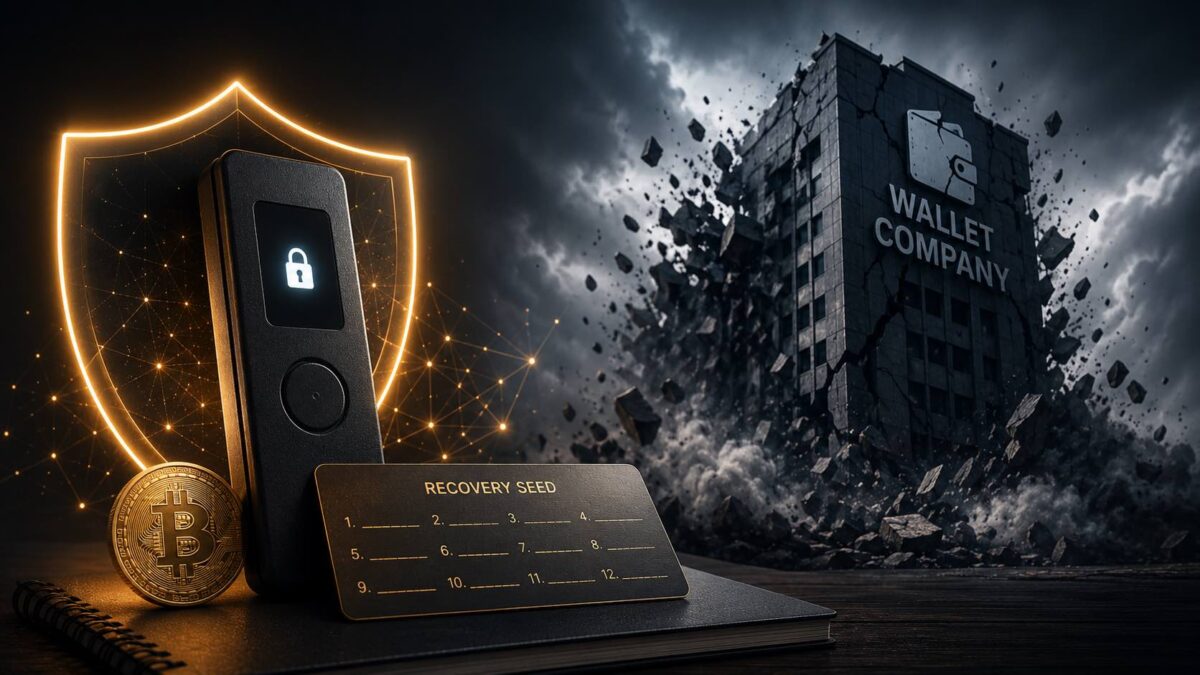
One of the biggest fears beginners have in crypto is what happens if the company behind their wallet suddenly disappears. If Ledger, Trezor, MetaMask, Trust Wallet, or another crypto company shut down tomorrow, would your Bitcoin or crypto disappear too? The answer depends on what kind of wallet you are using and whether you actually control the recovery phrase yourself. This is one of the most important ideas in crypto security because many beginners confuse the wallet company with the crypto itself.
📑 Table of Contents
Quick Answer
In many cases, your crypto can still remain safe even if the wallet company disappears. That is because your coins are not actually stored inside the app or hardware wallet itself. They exist on the blockchain, and access is controlled through your private keys and recovery phrase. If you control those backups properly, you can often restore access using another compatible wallet.
Crypto Security Tip
In self-custody, the recovery phrase matters far more than the wallet company name itself.
Do You Actually Own Your Crypto?
One of the most confusing things for beginners is understanding where crypto actually lives. Many people imagine Bitcoin sitting inside an app or inside a hardware wallet device, but that is not really how it works. Your crypto exists on the blockchain itself. The wallet simply gives you the credentials needed to access and control it.
Those credentials are called private keys. In plain English, they are the secret access codes that prove ownership. Modern wallets usually simplify this process by giving you a recovery phrase, sometimes called a seed phrase, which can recreate those keys if needed.
This is why self-custody matters so much. If you control the recovery phrase yourself, you are not completely dependent on the company that created the wallet software or device.
Wallet Company vs Your Crypto
A wallet company and your crypto are not the same thing. This distinction is critical. In many self-custody setups, the company provides the interface, app, updates, and device ecosystem, but they do not actually control your coins.
Think of it like this: the wallet company builds the tool, but the blockchain is where the crypto actually exists. If the tool disappears but you still have the recovery phrase, you can often access the same funds through another compatible wallet.
This is one reason many people see self-custody as a major advantage over leaving funds entirely on exchanges.
What Happens With Ledger or Trezor?
If a hardware wallet company such as Ledger or Trezor disappeared tomorrow, your crypto would not automatically disappear with it. Assuming you still have your recovery phrase, you could normally restore access using another compatible wallet.
That is because most major wallets use standard recovery systems that are compatible across many other wallets. In practice, this means your seed phrase could often be imported elsewhere if needed.
This is also why protecting the recovery phrase is far more important than protecting the device itself. A broken hardware wallet can usually be replaced. A lost recovery phrase is much more serious.
What About MetaMask or Trust Wallet?
The same broad principle usually applies to many software wallets too. If MetaMask or Trust Wallet disappeared as companies, users who properly backed up their recovery phrase would often still be able to restore access elsewhere.
The key issue is whether you control the recovery credentials yourself. If you do, the wallet app is more like a doorway than a vault. The crypto is still on the blockchain, and another compatible doorway can potentially access it.
You can learn more in our guides on MetaMask safety and Trust Wallet safety.
Why the Recovery Phrase Matters
The recovery phrase is usually the single most important part of self-custody. It is the backup that can recreate the wallet somewhere else if needed.
This means the recovery phrase can often survive:
- A lost hardware wallet
- A broken device
- A deleted app
- A bankrupt company
- A new replacement wallet
But it also means that if someone steals your recovery phrase, they may be able to access your funds too. This is why recovery phrase security is such a huge topic in crypto.
Crypto Security Tip
Never store your recovery phrase in screenshots, cloud notes, email drafts, or messaging apps.
What If the App Disappears?
Another fear beginners have is what happens if the app itself disappears from the App Store or stops being updated. In many cases, this still does not necessarily mean the crypto is lost.
Because crypto wallets often use open standards, another wallet may still support the same recovery phrase and blockchain access. This is one reason crypto can be surprisingly resilient compared with normal accounts tied directly to one company platform.
However, this also assumes you have backed everything up correctly beforehand.
Custodial vs Self-Custody Risk
This conversation becomes very different when talking about custodial services. In custodial systems, another company controls the private keys for you. That means access depends much more heavily on the company surviving and operating properly.
This is why the collapse of exchanges such as FTX created such massive problems for users. Many people did not actually control their own crypto directly.
Self-custody changes that relationship. It gives you more ownership and independence, but it also gives you more responsibility.
How to Protect Yourself
The best protection is understanding how recovery and self-custody actually work before problems happen.
Good beginner habits include:
- Backing up the recovery phrase offline
- Testing recovery procedures carefully
- Avoiding phishing scams
- Learning the basics of self-custody
- Using reputable wallets and platforms
For broader context, it is worth reading Are Crypto Exchanges and Wallets Safe? as well.
Wrap-Up
One of the most powerful ideas in crypto is that your assets are not necessarily tied to a single company. In proper self-custody systems, your recovery phrase is often the true foundation of access, not the wallet brand itself.
That means a wallet company disappearing does not automatically mean your crypto disappears too. If you have backed up your recovery phrase properly and understand the basics of self-custody, there is often a path to restoring access elsewhere.
The important thing is preparation. The people who usually struggle most during crypto failures are the ones who never learned how their wallets actually worked in the first place.
Mini-FAQ
Can I still access my crypto if Ledger shuts down?
What happens if MetaMask disappears?
Is my crypto stored inside my wallet app?
What is the most important thing to protect?
Disclaimer: This guide is for educational purposes only and does not constitute financial, legal, or cybersecurity advice. Always verify wallet apps and devices through official sources, and never share your recovery phrase, seed phrase, or private keys with anyone.